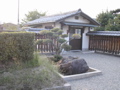
ok, so here begins the middle part of my trip to nara, after the taiko drummers and bit of arcade hopping. i'm not exactly sure the name of the place i'm at here, but it was just a tiny bit off the main shopping street and housed a (then closed and sadly unviewable) graveyard. i just like the little bonsai-lookin' tree. :)
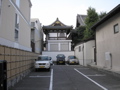
a random shot of a side street. i just liked the contrast of old versus new. japan has absolutely no qualms about mixing ancient traditions with modern advances. and somehow they pull it off rather seamlessly.
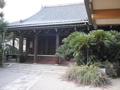
walking a bit further, i found joukyouji temple. 'sacred' structures and areas in japan typically come in two types: buddhist temples (like this one) and shinto shrines. the differences between the two practices could fill volumes, so it's just easiest to remember that 'temple=buddhist' and 'shrine=shinto'.
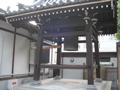
a big buddhist bell inside joukyouji. i don't know enough about buddhism to tell you the exact signficance or purpse, but they're always impressive nonetheless. i like the suspended wooden clappers used to ring such bells, and the low, resonant gong they make is beautiful.
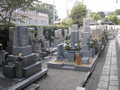
inside joukyouji temple was a buddhist graveyard. most people in japan are cremated and not actually buried (for a plethora of reasons) - i'd guess to be buried in an historical temple like this one you'd need to be fairly weathly.
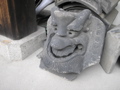
an awesome roof corner decoration that had been taken down for some reason - perhaps to be cleaned.
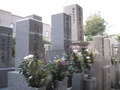
another shot of the graveyard. i love how they truly look like little cities of the dead.
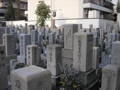
apparently, the founder of joukyouji temple was a priest who had previously been a warrior known for his wisdom and bravery in the mid 13th-century. it's always amazing to me to walk among temples and grounds that have stood for more than half a millenium.
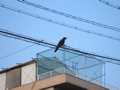
i was too slow on the draw for this pic; moments before, this guy was atop one of the gravestones, tearing at something that i was hoping would be a human skull, or at least an eyeball. turns out it was a cupcake. i got his pic either way.
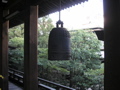
another great bell inside joukyouji.
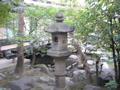
also inside joukyouji is a small, tranquil garden. the fact that not more than 100 yards away is a bustling shopping district simply accentuates japan as a land of striking yet harmonious contrasts.
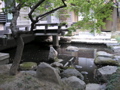
another shot of joukyouji's garden. notice the momiji (japanese maple) there. by late november, all those leaves will turn a blazing red. i'll try to remember to come back here then to get a contrasting shot.
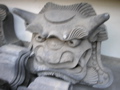
another (rather blurry) roof corner decoration. being able to touch these things and feel their textures is a real treat.
what japanese garden would be complete without a pond full of fish? i think these little guys are goldfish, and not actually proper koi.
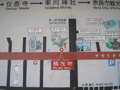
We Are Here! i took this shot as a memory marker so i could recall where i was and what i visited. and in fact, i'm about to enter...
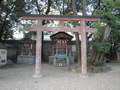
...isagawa shrine. those big, red shinto gates (called torii) mark spots where the divine world connects with the mundane world, and by passing through them you put yourself into the realm of the divine.
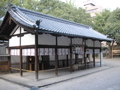
the main hall of isagawa shrine.
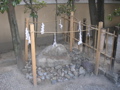
a rock inside isagawa that's being marked as sacred by the presence of the shimenawa (straw ropes) and gohei (folded paper zig-zags). yup, sacred rock. ya heard me!
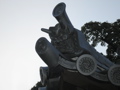
another one of the demonic corner tiles i love so much, this one on active duty.
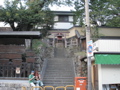
again, a typical seamless merging of the old and new. this shot was taken directly off the bustling sanjoudori shopping street, the stairs leading up to a small shinto shrine.
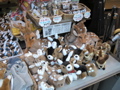
so. yeah. deer schwag. and looooots of it. you'll soon see the huge and amazing significance of deer in nara... :)
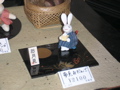
yeah, another cute rabbit. the standing placard says 'otsukimi' or 'moon viewing'. the price tag says 'yumeusagi odango', which as best as i can translate means 'dream rabbit dumplings' (and you can see the dumplings on his little wooden tray).
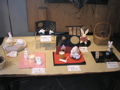
the rest of the rabbit party, with more dumplings and more moons. interestingly enough, the japanese don't see a 'man in the moon' amid the shaded patterns of the moon like we do. they see a 'rabbit in the moon', the full story of which i'll relate another time. :)
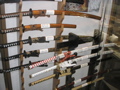
souvenir (and entirely decorative) katana galore, pricing in at about $60 apiece. katana (among other things) in japan are one of those items that could cost you anywhere from $60 for these cheapies to More Money Than You Could Ever Dream Of for a genuine, legendary article.
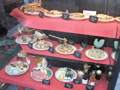
more fake plastic food. the floating chopsticks are a nice touch.
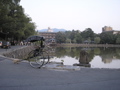
a rickshaw (or 'jinrikisha' in japanese) parked at the edge of sarusawa-ike pond. just north of here is the stunning kofukuji temple, which i'll get to in a moment.
a wee turtle swimming about in sarusawa-ike. and he's not alone...
...he's got about twenty of his closest friends with him, all umping away on the bread bits tossed in by observers.
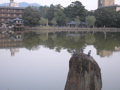
a trio of pigons perched atop a rock in sarusawa-ike pond. amusingly, 'sarusawa' means 'monkey swamp'. kate will be pleased to know that on march 13th, a shrine in this immediate area celebrates the 'kasuga matsuri', or 'monkey festival'. yes, we are *so* there.
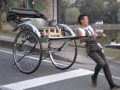
a rickshaw driver coming to a rapid halt. rickshaws are kinda the equivalent of taking a horse and buggy ride in america; a quaintly charming experience to take for special or romantic occasions.
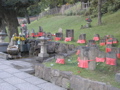
here i began to ascend into kofukuji temple. kofukuji was founded in the 7th century by a member of the fujiwara clan to pray for the clan leader to recover from illness. the red bibs on the statuary signify divine protection, and are very commonly seen in both temples and shrines. you can also see the sake cups of offering before many of the statues.
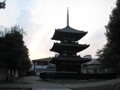
a beautiful three-storied pagoda inside kofukuji temple. the long 'antennae' at the top of pagodas are called 'finial'. they function as lightning rods, and help to both attract lightning and protect the pagoda from lightning damage. this attraction of lightning further marks pagodas as being spiritually charged.
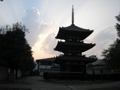
man...how can one *not* be enthralled by the majesty of sights such as these? it could almost make even the stoic josh k believe in the divine. :)
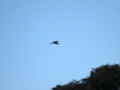
this guy *was* perched very attractively atop the previous pagdoa, but took off when he realized i wanted his picture. i snapped this shot just because i wanted to see if i could track and shoot a bird in flight. i did alright. :)
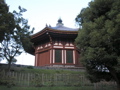
an unknown structure inside kofukuji temple.
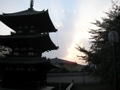
another divine view of the three-storied pagoda inside kofukuji.
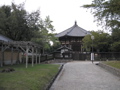
more of the kofukuji temple grounds.
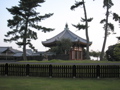
more kofukuji.
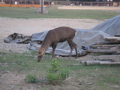
this little guy was the very first deer i ran across in nara, inside kofukuji. i thought it was a pretty special sighting, so i snagged his picture. you can tell tell he's male because of his trimmed antlers. more on the deer in a bit!
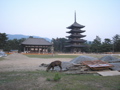
another shot of mister deer, with kofukuji's second (and five-storied) pagoda in the background.
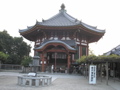
this is kofukuji's 'nanendo', or southern octagonal hall. it enshrines the main altar piece of the bodhisattva (an enlightened and powerful being of buddism) of the "unfailing fishing line". this particular bodhisattva uses a fishing net or line to catch and help people who are suffering.
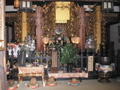
a close-up of the inside of a little prayer hall near the nanendo inside kofukuji. notice the little brown thingers with the mallets in front of them at the bottom. i don't know their significance, but as one fellow was praying he rhythmically beat it like a drum.
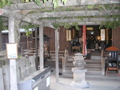
a further back shot of the same prayer hall. you can see an incense brazier in the foreground; the sweet smell of authentic temple incense is unmistakable and quite alluring. i bought myself a bundle of it to take home for about 50 cents.
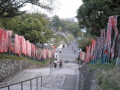
a long flight of stairs leading back down to sarusawa pond. i'm unsure as to the significance of the many banners lining the stairs.
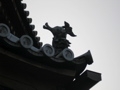
a little demon-lion guy decorating a rooftop in kofukuji.
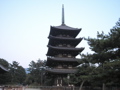
another shot of the five-storied pagoda of kofukuji temple.
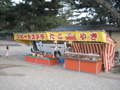
a pair of food vendors inside kofukuji. the right is selling the very common (and in this instance, rather jolly) 'takoyaki', batter-fried octopus. the left is selling 'kasutera', little sponge cakes. the term 'kasutera' comes from the foreign word 'castilla', though i'm not sure what the root language is.
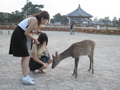
another deer in kofukuji. so here's the deal: in nara, deer are sacred and symbols to the shrine of kasuga shrine. in the past, these deer were considered to be messengers of the gods, and today, they enjoy the status of national treasures and are free to roam the park and its surrounding areas.